- Physical activity of any kind, be it walking or going to the gym is good for the mind, body and soul.
- A single session of moderate to vigourous activity has been shown to improve sleep, thinking and learning, while reducing symptoms of anxiety.
- Regular exercise helps us to recharge. Even though it uses energy it then feedbacks energy by making us feel more alert, as well as increasing our physical energy capacity.
- Exercise can be a time of reflection and review, which can then help with problem-solving.
- For others, exercise provides a good opportunity to switch off and clear their mind.
- Exercise can be helpful in boosting our mood. Studies show that exercise is a useful therapy for mild to moderate depression. It also helps with better stress management.
- Being physically active helps to boost our immune system.
- Regular exercise also reduces medical risk factors such as overweight and obesity, high blood pressure and high blood cholesterol.
- If you exercise with a group, then the exercise has the added efficiency of reaping the benefits of maintaining social connections. Having a good laugh, or a useful download, with a group of friends can be very therapeutic.
Lifestyle
Physical Activity and Exercise
Our bodies are made to move and the physical and mental benefits associated with physical activity are well documented. Exercise reduces your risk and can help to manage several chronic conditions such as cardiovascular disease, type II diabetes and some cancers. It also helps to prevent unhealthy weight gain and to build strong muscles and bones, which are crucial to maintain functional independence as we age.
Benefits of Physical Activity and Exercise

More About Physical Activity and Exercise
Being physically active and limiting your sedentary behaviour is essential for health and wellbeing.
Australian Physical Activity & Sedentary Behaviour Guidelines for Adults (18 – 64 years) includes:
- Be active on most, preferably all, days every week.
- Accumulate 150 to 300 minutes of moderate intensity physical activity or 75 to 150 minutes of vigorous intensity physical activity each week.
- Do muscle strengthening exercises on at least 2 days each week.
- Minimise the amount of time spent in prolonged sitting
- Break up long periods of sitting as often as possible.
What is Exercise Intensity?
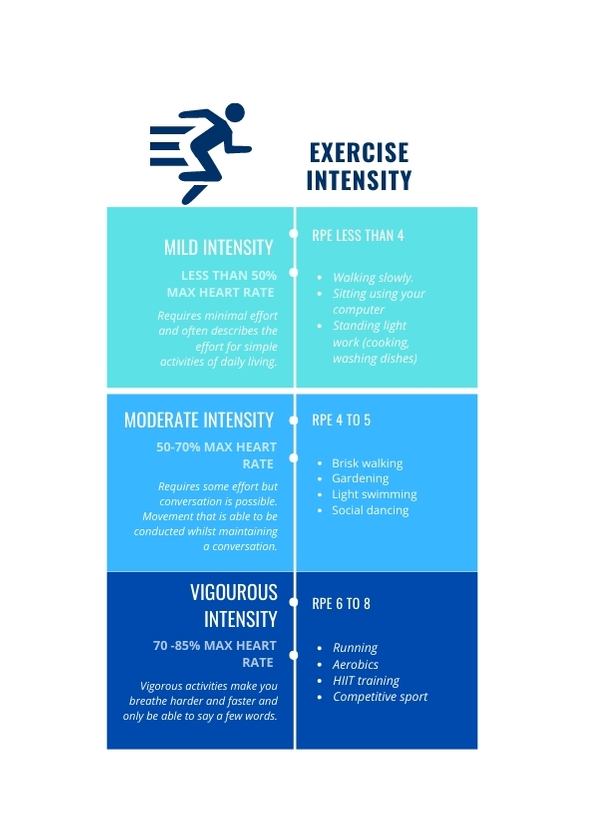
Intensity is one of the primary variables in exercise that can be altered to increase difficulty and cause physiological adaptations as you continue to improve your fitness. Below is a table describing 3 primary intensities, their definition, examples of exercises used at these intensities and how you can measure intensity.
Methods of measuring Intensity
Rate of Perceived Exertion (RPE):
- The Borg RPE scale is a way of measuring physical activity intensity level or how hard you are working.
- Self-monitoring your RPE can help you to determine the level of intensity of your exercise and allow you to make adjustments depending on your goal and level of fitness.
- It is a fairly accurate method given its simplicity.
Heart rate monitoring:
- Monitoring heart rate can be taken manually by checking your pulse, however, this can be quite inaccurate at high intensities.
- The preferred method is a heart rate monitor which have recently become more and more common with wearables and smart watches.
- To use the heart rate intensities below, you will firstly need to calculate your maximal heart rate at Max Heart Rate = 220 — Age
Impacts on:
- Medical
- Sleep
- Lifestyle
- Work
- Connections
- Resilience
Strategies to Improve Physical Activity and Exercise
1. Active travel.
Linking exercise with your commute to work can be helpful for some people wanting to fit exercise into an already busy life. If you catch public transport try getting off one or two stops earlier and then walking the rest of the way to work or home. If feasible, try cycling, running or walking to work.
2. Exercise in a group.
- If you struggle to maintain motivation for regular exercise, consider a personal trainer or joining an exercise group.
- Join a weekend exercise group — for example cycling or bushwalking.
3. Choose an activity you enjoy.
- Pick something you enjoy and will be convenient to do or access. Start out gradually and set yourself an achievable goal, even 2 days a week is better than no exercise at all when you are starting out. Be flexible and forgiving — if you miss a day, that is ok. Just try again the next day or the next week. Each day is a new day and an opportunity to start again.
- Think laterally — dancing is also a good form of exercise, as are activities like Zumba.
4. Physical activity at home.
Having an exercise bike or treadmill at home is helpful for those who have busy family commitments as it means you don’t need to leave the family in order to exercise.
There are also many useful apps and video’s to guide you through exercise at home. Try the “30 Minute Boosted Fitness Walk | Walk at Home” program – it’s handy for those rainy days too!